Battery Storage Solutions

The general philosophy of solar battery storage systems revolves around harnessing, storing, and efficiently utilising renewable energy generated from solar panels.

By incorporating these principles, solar battery storage systems offer a comprehensive solution for efficient, sustainable, and cost-effective energy management.

What type of battery storage solution is right for you?

There are essentially two types of solutions, each with its own set of advantages and disadvantages. Both options offer good reasons to be considered and can be beneficial depending on specific needs and circumstances.

AC Coupled PV Inverters

AC coupled PV systems connect solar panels and battery storage through separate inverters. The solar inverter converts DC electricity from the panels to AC for household use, while a storage inverter converts AC back to DC for battery storage. This setup allows easy integration with existing solar installations and flexibility in system sizing and upgrades.

AC coupled systems enable existing solar PV systems to have a battery storage added to any brand of inverter equipment. This is particularly important to those that have a FIT payment and do not want to lose that benefit. They can also provide emergency power backup during grid outages and enable smooth connectivity with the utility grid, allowing participation in energy markets.

While AC coupled systems offer many benefits, there are a few factors to consider. They require additional equipment, which might increase installation costs and space requirements. There can be some efficiency loss when converting AC power from an existing solar inverter back to DC for battery storage. However, despite these considerations, the advantages of AC coupled storage remain significant.

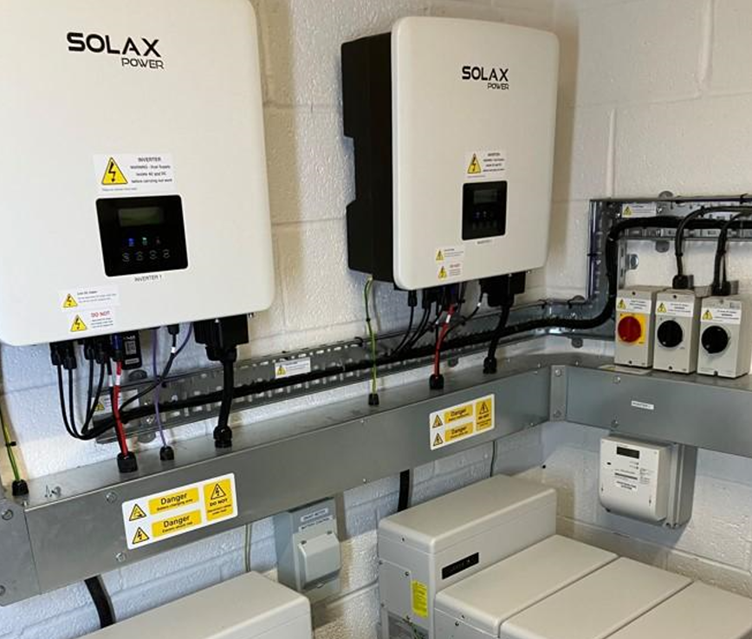
Example of an AC-coupled solution.
13.5 kWh system in Luton, Bedfordshire. By GSE.

DC-coupled Hybrid PV Inverters

Hybrid PV systems combine solar panels, a hybrid inverter, and battery storage to create a seamless energy solution. The solar panels generate DC electricity, converted to AC by the hybrid inverter for immediate use. Excess energy is stored in the battery for later use, ensuring continuous power supply during outages. Hybrid systems offer benefits of both grid-tied and off-grid systems, providing energy security and cost savings.

Hybrid inverters offer several advantages. They provide energy independence by storing excess solar energy in batteries, reducing reliance on the grid and ensuring backup power. They are cost-efficient as they integrate multiple functions into one device, lowering overall system costs. These inverters also offer intelligent energy management by automatically switching between solar, battery, and grid power based on availability and cost, optimizing energy use. Additionally, hybrid inverters are flexible, operating in various modes such as grid-tied, off-grid, and backup, making them versatile for different needs. They also optimize space by combining solar and battery inverter functions into one unit, simplifying installation.

Example of a DC-coupled hybrid solution.
60kW, 90kWh system. By GSE.

Interested in battery storage?

For more information or a quote, please get in touch.